
LED Story
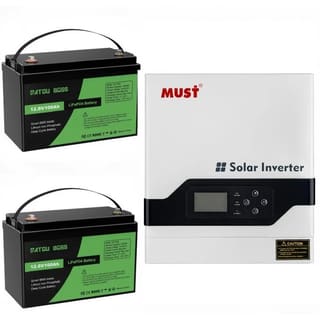
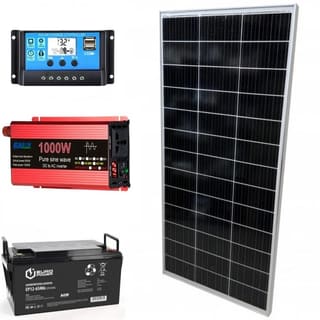
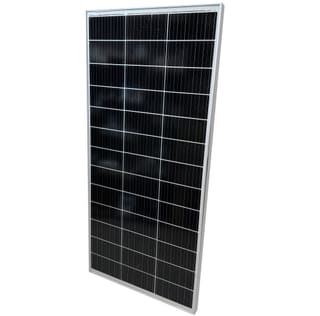
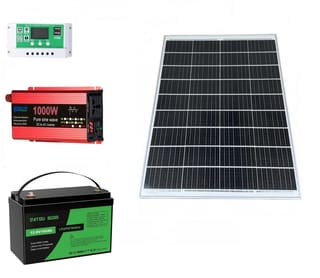
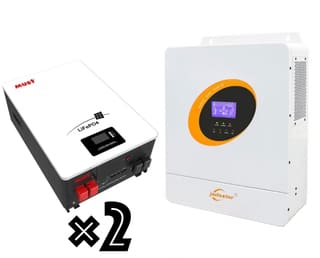
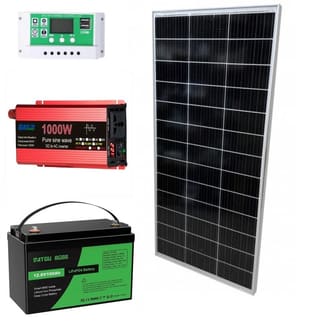
Портативная электростанция для дома 500Вт с солнечной панелью 200W и АКБ LiFePO4 12.8V 100Ah (1280W) инвертор 500Вт (макс 1000Вт) чистая синусоида + ШИМ 30А
200 Вт · 44 В · IP67
UAH 19,590In stock
Electrical
Energy
Lighting
Buying guides
Sizing backup power comes down to four numbers: the load power, the starting current, the hours you need and the system voltage. Below: a table of typical loads, formulas for the inverter and the battery in Wh and Ah at 12, 24 and 48 V, LiFePO4 compared with gel, and an example for a flat over 8 hours.
List everything that has to keep running during an outage, with its actual power draw — from the data sheet or the rating label on the case. For motors and compressors, account separately for the starting current: at start-up they draw 2–3 times their rated power for about a second.
| Load | Power, W | Start | Note |
|---|---|---|---|
| Router and optical terminal | 10–20 | — | Runs continuously |
| LED lighting for a flat | 40–80 | — | 5–8 luminaires of 8–10 W |
| Laptop | 45–90 | — | Charging plus use |
| Television | 60–150 | — | Depends on the screen size |
| Gas boiler with circulation pump | 80–150 | ×2 | Sensitive to the waveform and to phasing |
| Refrigerator | 100–200 | ×3 | The compressor runs in cycles |
| Desktop computer with monitor | 200–400 | — | Gaming machines draw more |
| Water supply pump | 500–1 000 | ×3 | The highest starting current |
| Microwave oven | 1 000–1 300 | — | Draws more than the figure on the door |
| Electric kettle, water heater, heater | 1 500–2 500 | — | Usually left off the backup: they drain the battery within an hour |
The inverter must carry the sum of the continuous loads with a margin and withstand the start of the largest motor.
Pinv = ΣP × 1.25, where ΣP is the total power of the loads switched on at the same time. The 25 % margin covers heating, inaccuracy in the data sheet figures and new appliances.
Ppeak = ΣP + Pmotor × (k − 1), where k is the starting factor of the most powerful motor. The inverter’s peak power (listed separately in the data sheet, usually twice the rated power for a few seconds) must be no lower than Ppeak.
Other requirements: a pure sine wave — for a boiler, a fridge, pumps and any equipment with a motor or a switch-mode power supply; a modified sine wave suits only lamps and chargers. For a boiler — correct output phasing (phase and neutral are not swapped) and a transfer time of no more than 10–20 ms if the inverter works in UPS mode.
A battery is sized by energy, not by power. First, how many watt-hours have to be delivered; then, how many ampere-hours that means at the chosen voltage.
E = ΣP × t ÷ η ÷ DoD, where t is the hours of autonomy, η is the inverter efficiency (0.9), DoD is the working depth of discharge: 0.9 for LiFePO4, 0.5 for gel and AGM.
C = E ÷ U, where U is the system voltage: 12, 24 or 48 V. The result is in ampere-hours.
| Energy required, E | 12 V | 24 V | 48 V |
|---|---|---|---|
| 1 000 Wh | 83 Ah | 42 Ah | 21 Ah |
| 2 000 Wh | 167 Ah | 83 Ah | 42 Ah |
| 4 000 Wh | 333 Ah | 167 Ah | 83 Ah |
| 8 000 Wh | 667 Ah | 333 Ah | 167 Ah |
The system voltage follows the inverter power: up to 1–1.5 kW — 12 V, 2–3 kW — 24 V, from 3–5 kW — 48 V. The higher the voltage, the lower the current in the cables: 3 kW at 12 V means 250 A and cable from 70 mm², at 48 V — 63 A and 16 mm².
| Parameter | LiFePO4 | Gel / AGM |
|---|---|---|
| Working depth of discharge | 80–90 % | 50 % |
| Service life | 3 000–6 000 cycles | 500–800 cycles |
| Weight per 1 kWh | 10–12 kg | 25–30 kg |
| Charging rate | 0.5–1C, 1–2 hours | 0.1–0.2C, 8–10 hours |
| Operation in frost | Discharge down to −20 °C, charging only above 0 °C (the BMS blocks it) | Works, but capacity drops by 30–50 % |
| Price per kWh | Higher up front | Lower up front |
| Price per cycle | 3–5 times lower | Higher |
Gel makes sense for occasional outages and small UPS units where the battery stays charged for years. For daily cycling choose LiFePO4: it delivers twice as much from the same rated capacity and lasts 5–8 times longer.
The battery has to recharge between outages. The charging current of a hybrid inverter is usually 20–60 A; a 48 V 100 Ah battery charges from empty at 40 A in 2.5–3 hours, a gel battery of the same size takes 8–10 hours at a low current.
Solar panels reduce dependence on the outage schedule: 1 kW of panels yields 4–5 kWh a day in summer and 1–1.5 in winter. Panels need an MPPT controller or a hybrid inverter with a PV input; the voltage and current of the panel array are checked against the input range.
Load: router 15 W + lighting 60 W + laptop 65 W + boiler with pump 120 W + fridge 150 W = 410 W.
Inverter: 410 × 1.25 = 513 W. Peak: 410 + 150 × (3 − 1) = 710 W. A 1 000 W pure sine wave inverter with a 2 000 W peak meets both conditions.
Energy for 8 hours: 410 × 8 ÷ 0.9 = 3 644 Wh (the fridge runs in cycles, so the real figure is lower — we calculate with a margin).
LiFePO4: 3 644 ÷ 0.9 = 4 050 Wh → 12 V: 337 Ah; 24 V: 169 Ah; 48 V: 84 Ah. The practical choice is 24 V 200 Ah or 48 V 100 Ah (5.1 kWh): both leave a reserve for a long evening.
Gel: 3 644 ÷ 0.5 = 7 288 Wh → 12 V: 607 Ah, that is, six 100 Ah batteries weighing about 180 kg. That is why lithium is used for daily autonomy.
Calculation
Switch on what has to keep running during an outage and say for how many hours. You get the inverter power and the battery capacity.
We size the inverter with a 25 % margin over the total load and check it against the starting currents of the fridge and pumps. Capacity assumes 90 % inverter efficiency and a working depth of discharge of about 90 % for LiFePO4 and 50 % for gel and AGM batteries.
Select at least one load.
See in the catalogue
LED Story
200 Вт · 44 В · IP67
LED Story
3024 Вт · 12 В · 1280 мА·ч
LED Story
200 Вт · 44 В · IP67
LED Story
3024 Вт · 12,8 В · 2048 мА·ч
UKC
200 Вт · 38 В · IP67
LED Story
100 Вт · 44 В · IP67
LED Story
5500 Вт · 25,6 В · 5120 мА·ч
Buying guides
Lighting for a workshop or a warehouse is calculated from the required level in lux, not from “watts per metre”. Below: typical levels under DBN V.2.5-28 (the Ukrainian lighting standard), the utilisation factor method with its formula, choosing a luminaire by ceiling height, IP and IK requirements and a worked example for a 30 × 18 m warehouse with an 8 m ceiling.
Read
Warm or cool light is chosen for what the room is used for, not by taste. Below: the kelvin values for the bedroom, kitchen, bathroom, children’s room, study and garage, the rule of one colour temperature per zone, and why 6500 K in a bedroom keeps you awake.
ReadContact