How to read an IP code
An IP code has two digits. The first is protection against dust and solid objects: 4 — against objects larger than 1 mm, 5 — dust gets in but does not affect operation, 6 — dust-tight. The second is protection against water: 4 — splashes from any direction, 5 — water jets, 6 — powerful jets, 7 — temporary immersion up to 1 m for 30 minutes, 8 — continuous immersion at the depth stated by the manufacturer.
Outdoors, the second digit is what matters:
- IP44 — a canopy, a porch, a covered terrace that slanting rain does not reach.
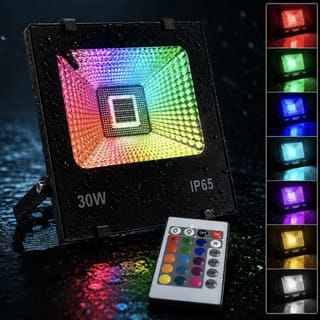
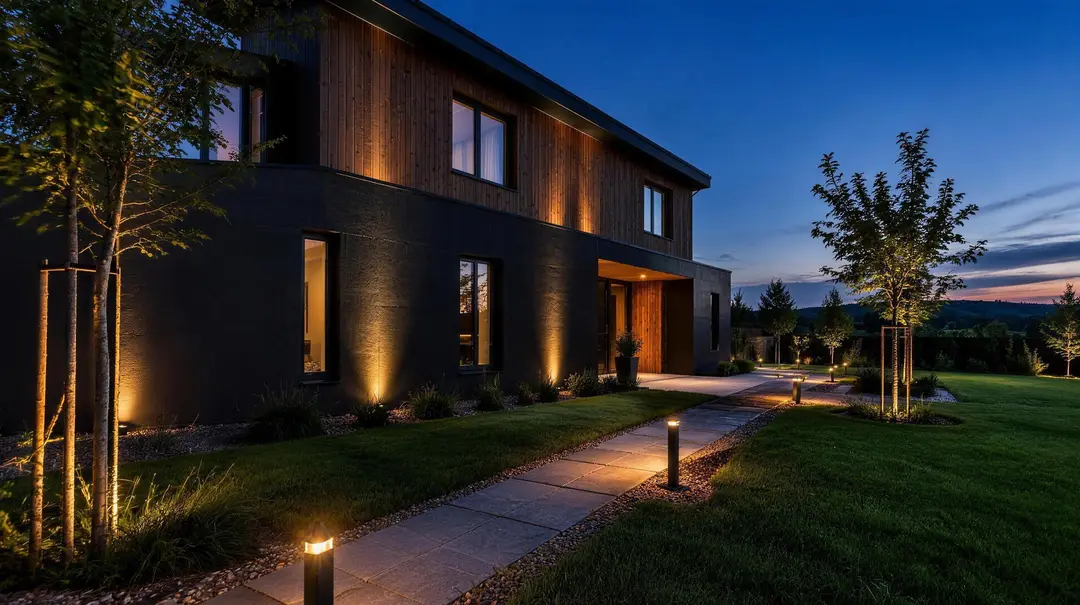
- IP65 — open façades, garden bollards, floodlights, bracket-mounted street lights: the standard for anything that gets wet.
- IP67 — in-ground luminaires in puddles and snow, outdoor stairs.
- IP68 — fountains, swimming pools, ponds.
A high IP rating does not cancel the installation rules: the cable entry faces down, connections go in a sealed box or a cable joint with the same IP rating.
Housing material
Cast aluminium with a powder coating is the best choice for façades, floodlights and street lights: it does not rust, it dissipates heat and it withstands impacts. Thin anodised aluminium fades in the sun within 2–3 years, so look at the wall thickness and the paint.
Stainless steel AISI 304 — for garden bollards and luminaires near water, AISI 316 — for the coast, with salt in the air. Polished steel looks expensive but needs care.
Plastic (polycarbonate, ABS) is the budget option for garden globes and shades, and only with UV stabilisation: ordinary plastic turns yellow and brittle within a few seasons. On the other hand, a polycarbonate diffuser, unlike glass, does not break.
Silicone seals last longer than rubber ones, metal cable glands longer than plastic ones.
How much light you need
| Task | Flux and power | Luminaire type |
|---|---|---|
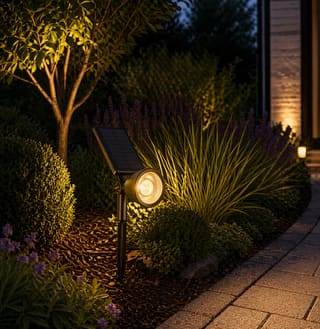
| Garden path | 100–300 lm per point, spacing 2–4 m | Bollards 30–60 cm high, in-ground luminaires |
| Porch, front door | 400–800 lm | Wall luminaire IP44–IP65 with a motion sensor |
| House façade | 600–1 500 lm per luminaire | Up-and-down façade lights, floodlights of 10–20 W |
| Yard, parking for 2–3 cars | 3 000–5 000 lm | A 30–50 W floodlight at a height of 3–4 m |
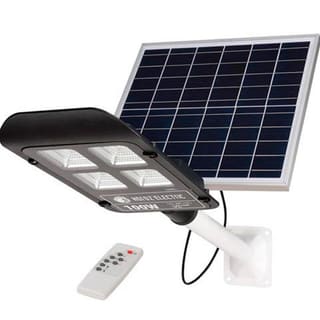
| Driveway, street | 6 000–12 000 lm per pole | A 50–100 W bracket-mounted street light at a height of 6–8 m |
Functional lighting — 4000 K: white enough for safety and without a dazzling blue cast. Decorative lighting in the garden and on the terrace — 3000 K.
Solar luminaires without illusions
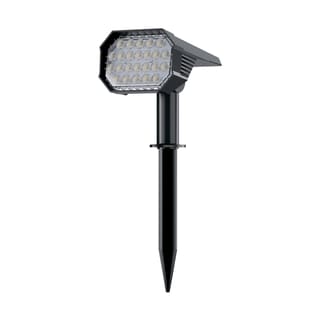
A solar luminaire is a panel, a battery, a controller and LEDs in one housing: no cable, installation in 10 minutes, light even during power cuts. The limitations:
- Weaker in winter. In December the day is three times shorter and the sun is low. Good models in economy mode shine all night at 30–50 %, cheap globes go out after midnight.
- The panel needs sun. In the shade of trees or on the north side of the house the battery will not charge — you need a remote panel on a 3–5 m cable.
- The battery is a consumable. Lithium-ion lasts 2–3 years, LiFePO4 5–7. Check whether it can be replaced.
- A motion sensor saves charge: the luminaire glows dimly and brightens when someone approaches, and the charge lasts all night.
Solar lanterns are for paths, gazebos, country cottages without wiring and as a backup in the yard. A driveway and a parking area that need full brightness every evening are more reliably powered from the mains.
Mains: cable, RCD, controls
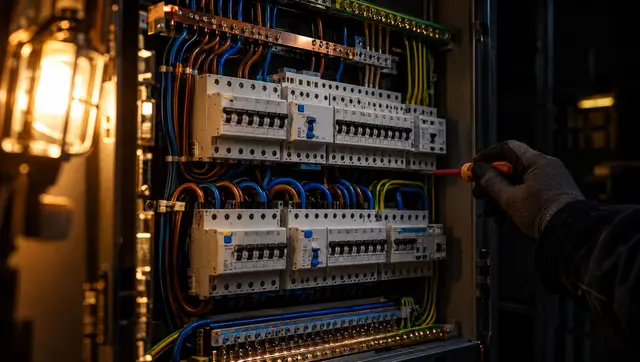
The mains gives a stable output all year round and any power you need, but it requires a circuit: VVGng or VVGng-LS cable (Ukrainian designations for flame-retardant and low-smoke PVC-insulated copper power cable) in corrugated HDPE conduit at a depth of 0.7 m or in a cable duct along the path, a breaker and a 30 mA RCD (residual current device), which disconnects the supply if the insulation is damaged. Connections — only in sealed IP65 boxes or cable joints.
For gardens there are low-voltage 12–24 V systems: an IP67 power supply by the house, and safe cable to the luminaires that can be laid at a shallow depth. Switching — a photocell at dusk, a timer, a motion sensor or a Wi-Fi relay on a schedule.
Checklist before you buy
- IP65 and above for everything under the open sky.
- Cast aluminium or stainless steel, a UV-resistant diffuser.
- An operating temperature from −30 °C, especially for batteries.
- 4000 K — functional light, 3000 K — decorative.
- Solar — paths and places without a cable; mains — driveway, parking, façade.
- A motion sensor or a photocell, so that the light does not stay on during the day.