
Prolum
Светодиодная лента гибкая 12V SMD 2835 120д.м. 6000K IP20 SG Упаковка 5 м
9 Вт · 6000 K · 12 В
UAH 79/мIn stock
Electrical
Energy
Lighting
Buying guides
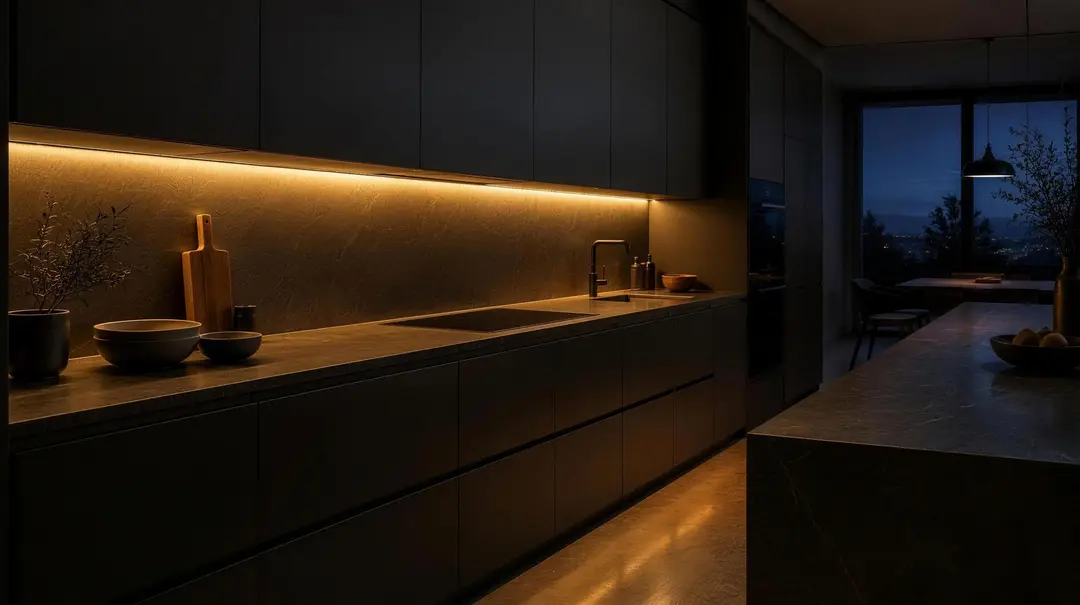
Worktop lighting usually goes wrong in three ways: the strip is too weak, there is no profile, the power supply has no headroom. Below: lumens per metre, IP by zone, the power supply formula and a worked calculation for a 3.2 m worktop.
Standards call for 300–500 lx on a kitchen work surface. For a strip under the wall cabinets, 50–60 cm above the worktop, that means 400–600 lm per metre. A frosted diffuser takes away 15–25 % of the flux, so with one take the upper end of the range or a little more.
If the lumens are not stated, work from the power: a good SMD 2835 strip gives 90–110 lm/W.
Over the worktop — 4000 K: you can see the colour of meat, the freshness of herbs, how well something is cooked. 3000 K makes white foods look yellow, 6000 K makes food look grey.
Colour rendering matters more than colour temperature: CRI 90 and above. A CRI 80 strip is cheaper, but reds and oranges look dull under it, and on food that shows.
A kitchen usually has 2–6 m of strip with one or two breaks under the extractor hood. Here 24 V pays off: half the current, a lower voltage drop towards the end of the run, thinner wires. 12 V is for sections up to 2–3 m or if you already have a 12 V power supply. Strip, power supply and dimmer — all for the same voltage.
In the dry zone under the cabinets IP20 is enough: an open strip is cheaper and cools better. Over the sink and within 50 cm of the hob you need IP65 in silicone, so that steam and grease do not reach the contacts. IP67–IP68 is excessive in a kitchen: that is the level for outdoors and ponds, and such strips dissipate heat worse.
Whatever the IP rating, do not mount the strip closer than 50 cm to the burners, or above a hob without an extractor: above 50 °C the life of the LEDs drops several times over.
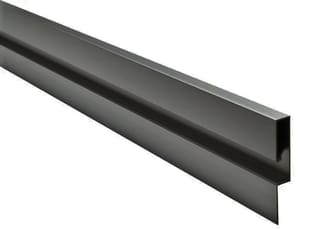
An aluminium profile dissipates heat, hides the dots behind a frosted diffuser and keeps the line straight. For a kitchen, surface-mounted 16–17 mm profiles on the underside of the cabinet and corner profiles work well: they light the worktop at 45° and do not dazzle people sitting at the table. Before the cabinets are hung, a recessed profile can be set into their base.
A strip above 8 W/m without a profile heats up to 60–70 °C and dims within a year or two. For 4.8 W/m a profile is optional, but a diffuser is needed, otherwise the dots glare on a glossy worktop.
Take a power supply with a 20 % margin over the strip power: that way it does not run at its limit, heats less and does not hum.
P = L × Pm × 1.2, where L is the strip length in metres, Pm is the power per metre from the specifications, 1.2 is the margin.
The result is rounded up to a standard rating: 36, 48, 60, 75, 100, 120, 150, 200 W.
An L-shaped worktop: 2.4 m along the wall, 0.8 m on the return, a 0.6 m break under the extractor hood. Strip: 2.4 + 0.8 = 3.2 m: 24 V, 120 LEDs/m, 9.6 W/m, 4000 K, CRI 90, IP20 in the dry part, and an IP65 section of the same power by the sink.
Brightness: 3.2 m × ≈950 lm/m ≈ 3 000 lm, more than 900 lm per metre — a reserve both for the diffuser and for dimming.
Kit: 3.2 m of surface-mounted profile with a frosted diffuser (two 2 m lengths), 2 end caps, a connector or a soldered link across the break, a touch dimmer with a hand-wave sensor in the profile or under the cabinet.
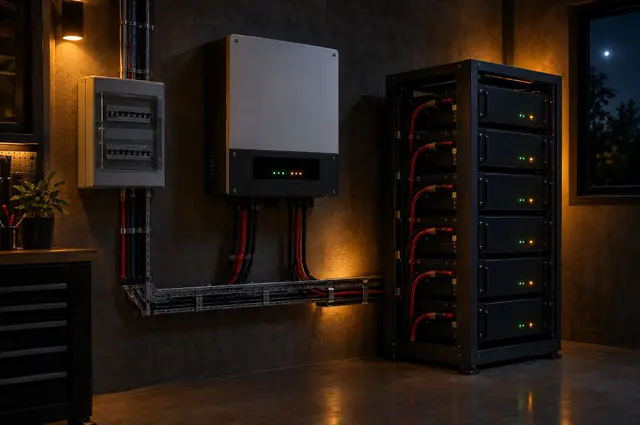
A 48–60 W power supply is the size of a cigarette packet. Its place is on top of a cabinet, in the plinth or inside a cabinet next to a socket, but not in a sealed box and not near the oven. The wire to a 24 V strip — 0.75–1.5 mm², up to 5 m.
It is more convenient to switch the strip separately from the main light: with a touch button in the profile, an IR hand-wave sensor under the cabinet, a dimmer with a remote control, or a 12–24 V Wi-Fi dimmer — from your phone and by voice.
Calculation
Length × watts per metre × 1.2 — and the standard power-supply rating.
The 20 % margin is mandatory: at its limit a power supply runs hot and fails sooner. The supply voltage must match the strip — 12, 24 or 48 V.
Above 5 m of 12 V strip, feed from both ends or split into sections
Matching power supplies
All products in this sectionSee in the catalogue
Prolum
9 Вт · 6000 K · 12 В
LED Story
10 Вт · 6000 K · 220 В
LED Story
50 Вт · 3000–6500 K · 220 В
UALED
10 Вт · 4000 K · 12 В
LED Technology
19 Вт · 12 В · IP20
UALED
Buying guides
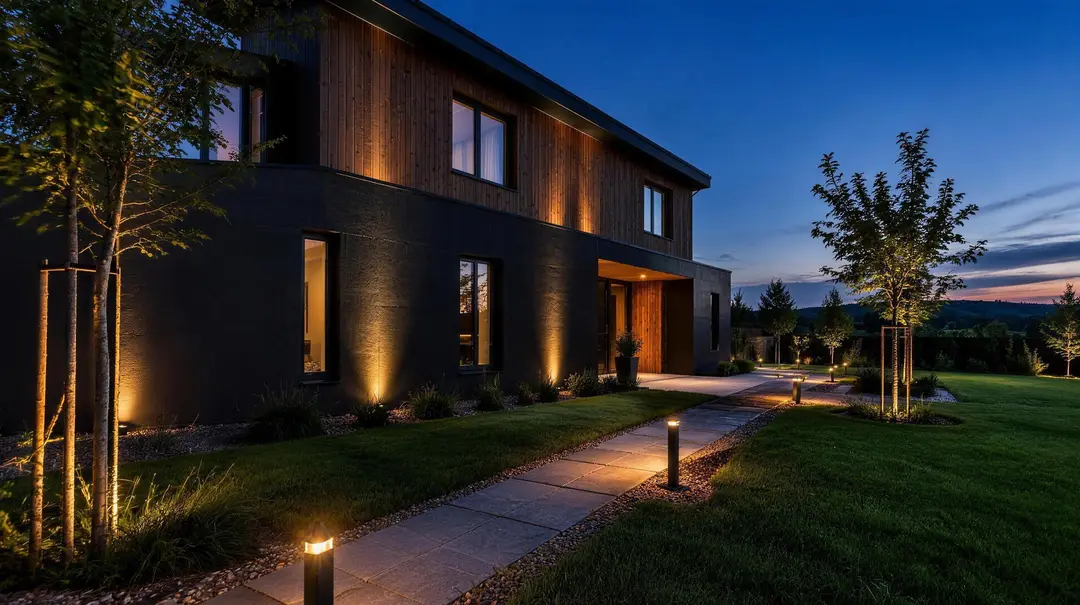
An outdoor luminaire works in rain, frost and heat. Below: which IP rating a porch, a façade and a pond need, why cast aluminium beats plastic, how long a solar lantern shines in winter and when it is worth running a cable after all.
Read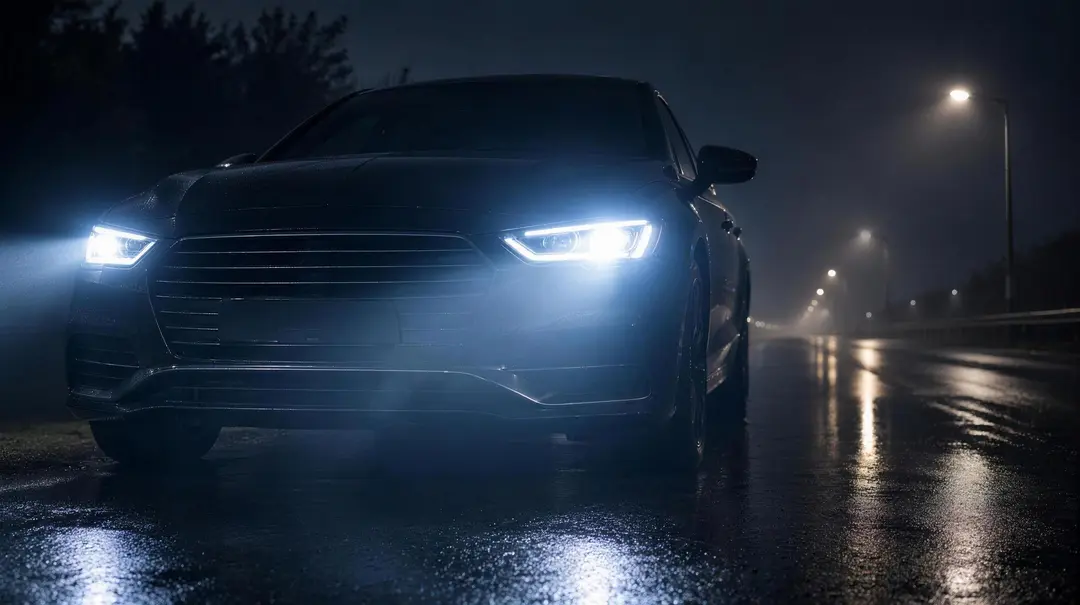
An LED bulb in place of a halogen one gives either clean white light or a blurred patch that dazzles oncoming drivers. The outcome depends on the base, the geometry of the LEDs and the type of headlight optics. Five selection steps, and an honest word on legality.
ReadContact