

Feron
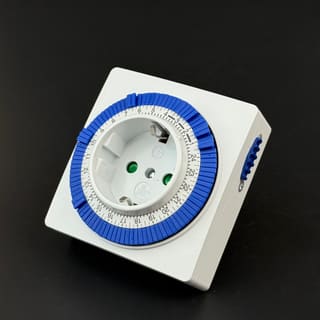
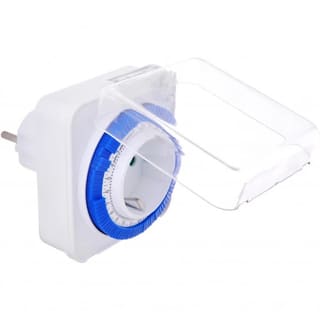
Розетка с таймером Feron TM31/61924 3500W/16A (суточная) с пыле-влагозащитой IP44
3500 Вт · IP44
UAH 440In stock
Electrical
Energy
Lighting
Buying guides
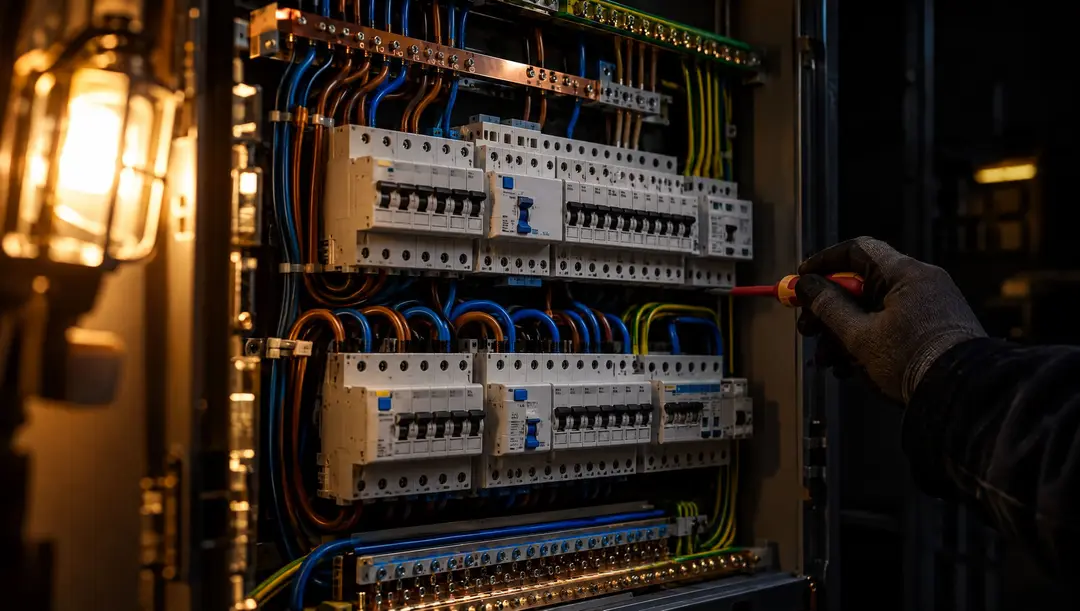
A breaker protects the cable, not the appliance: so its rating is chosen for the cross-section of the circuit, not for the power of the load. Below: curves B, C and D, a conservative “cross-section — breaker” table for copper wiring, 30 mA RCDs for damp areas and an example switchboard for a flat.
A circuit breaker opens the circuit in two cases: on overload (a current slightly above the rating for a long time — the thermal release trips within minutes) and on a short circuit (a current many times higher — the magnetic release trips within milliseconds). Both protect the cable insulation from overheating and fire. The appliance behind the breaker is protected by its own fuse or electronics.
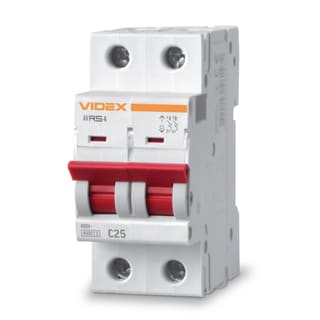
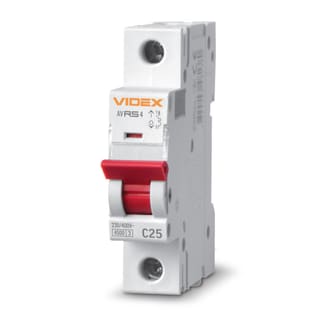
On the case: C16 — curve C, rated current 16 A; 4500 or 6000 — breaking capacity in amperes, the highest short-circuit current the breaker will interrupt without being destroyed; 1P/2P/3P — the number of poles. For flats and offices 4.5 kA is usually enough; closer to a substation and in industrial switchboards take 6 kA and above.
| Curve | Instantaneous trip | Where it is used |
|---|---|---|
| B | 3–5 × In | Lighting, sockets without motors, long runs and networks with a low short-circuit current (rural areas, the far end of a line) |
| C | 5–10 × In | The standard for flats, offices and shops with mixed loads: fridge, vacuum cleaner, power tools |
| D | 10–20 × In | Motors, compressors, transformers, welding — high starting currents |
The curve does not affect overload protection — the thermal part is the same. It only determines at what brief current surge the breaker trips instantly. A C breaker on a lighting circuit will work, but a B breaker clears a short circuit faster where the fault current is low.
There is one rule: the breaker rating must not exceed the continuous current rating of the cable. For copper conductors in typical domestic wiring (concealed, several cables side by side, ambient temperature up to 30 °C) the conservative values below apply. They follow established practice under the PUE (the Ukrainian Electrical Installation Rules); a single cable run on the surface can carry more current, but the breaker rating is raised only after a calculation.
| Copper conductor cross-section | Breaker | Approximate load, 220 V | Typical circuits |
|---|---|---|---|
| 1.5 mm² | 10 A | up to 2.2 kW | Lighting, ventilation. 16 A on 1.5 mm² is seen, but it is the limit — we do not recommend it |
| 2.5 mm² | 16 A | up to 3.5 kW | Sockets, washing machine, water heater up to 3 kW, air conditioner |
| 4 mm² | 25 A | up to 5.5 kW | Hob up to 5 kW, built-in oven, instantaneous water heater |
| 6 mm² | 32 A | up to 7 kW | Electric cooker, high-power hob, incoming supply of a small flat |
| 10 mm² | 40 A | up to 8.8 kW | Incoming supply of a flat or a house (according to the allocated capacity) |
An aluminium conductor carries less: for the same breaker take the next cross-section up. Long runs over 25–30 m are checked for voltage drop: if it exceeds 3–5 %, the cross-section is increased regardless of the current.
An RCD (residual current device) responds to leakage current — to earth or through a person — and disconnects the circuit within tens of milliseconds. It does not protect against overload, so it is installed together with a breaker or replaced by an RCBO, which combines both functions in one module.
The rated current of an RCD must be no lower than that of the breaker in front of it: after a C25 breaker — a 25 or 40 A RCD. On a lighting circuit an RCD is not mandatory, but it does no harm.
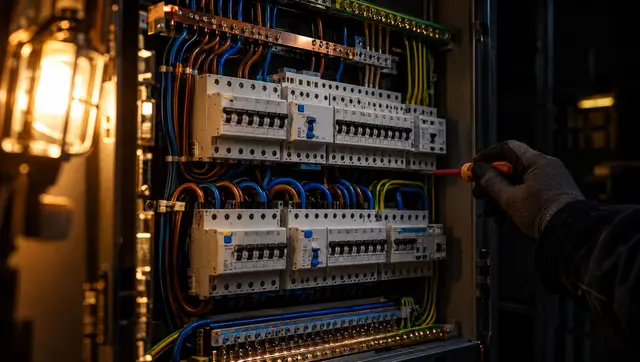
The incoming breaker is chosen by the allocated capacity and the incoming cable; the circuit breakers are one or two steps smaller, so that a short circuit in a socket trips only its own circuit, not the whole flat. A voltage relay goes right after the incoming breaker: it disconnects everything on a surge above 250–260 V or a sag below 170–190 V and reconnects after a delay. A modular contactor switches heavy circuits on a signal from a timer, a push-button or a relay: workshop lighting, a water heater on a schedule, a load fed from an inverter.
Each circuit gets its own breaker and its own cable. Do not combine lighting and sockets on one circuit: when a breaker trips, the lights should stay on.
| Circuit | Cable | Breaker | RCD |
|---|---|---|---|
| Incoming supply | 10 mm² | C40 2P | Fire-protection 63 A 300 mA (selective), voltage relay 63 A |
| Lighting | 1.5 mm² | B10 or C10 1P | — |
| Sockets, room and hallway | 2.5 mm² | C16 1P | 40 A 30 mA, shared with the kitchen |
| Sockets, kitchen | 2.5 mm² | C16 1P | 40 A 30 mA |
| Washing machine and bathroom | 2.5 mm² | C16 1P | RCBO 16 A 30 mA |
| Water heater | 2.5 mm² | C16 1P | RCBO 16 A 30 mA |
| Hob | 6 mm² | C32 2P | RCBO 32 A 30 mA |
| Air conditioner | 2.5 mm² | C16 1P | — |
About 19 modules in total: a 24-module enclosure leaves room for future circuits. Installation and connection are done by a qualified electrician; this table is for drawing up a specification and talking to them in the same terms.
Engineering calculation
Enter the power, supply and line length to get the design current, breaker rating, copper cable cross-section and voltage drop.
Indicative: copper in a wall or conduit, cos φ 0.95, C characteristic, voltage drop up to 5% for power circuits and up to 3% for lighting. The final choice follows the project and the wiring regulations (PUE), allowing for the installation method and temperature.
Above 125 A this is a service entrance or a main feeder. Send us the parameters and we will specify equipment for the project.
See in the catalogue
Feron
3500 Вт · IP44
Videx
IP20
Videx
4000 Вт · 250 В
Videx
4000 Вт · 250 В
Buying guides
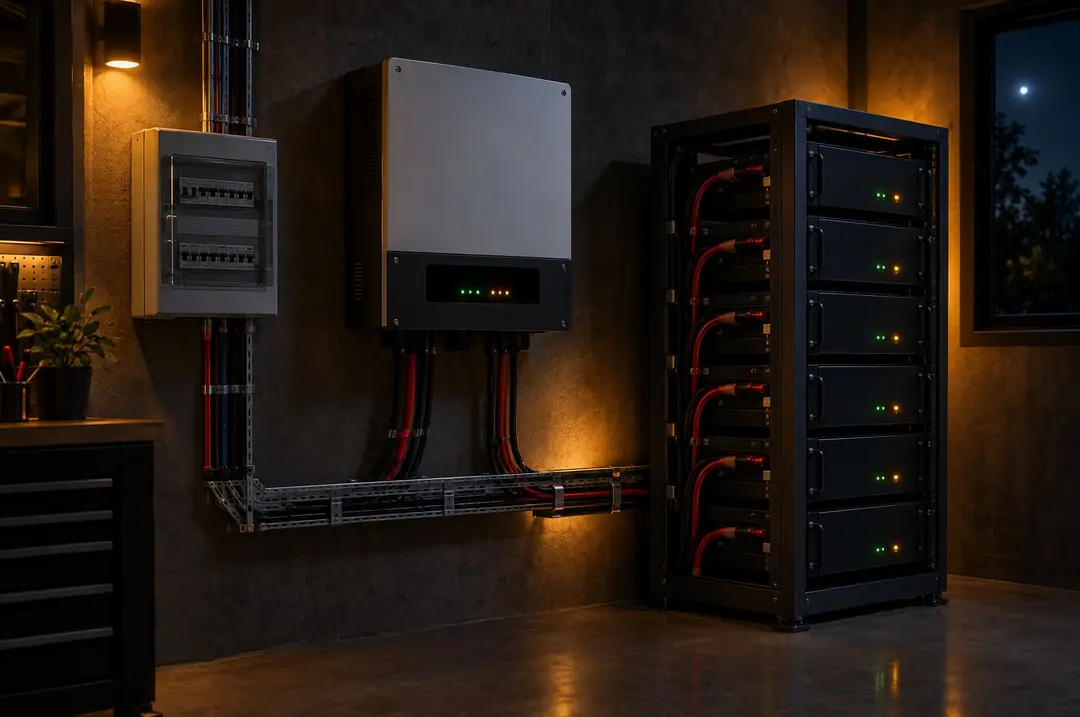
Sizing backup power comes down to four numbers: the load power, the starting current, the hours you need and the system voltage. Below: a table of typical loads, formulas for the inverter and the battery in Wh and Ah at 12, 24 and 48 V, LiFePO4 compared with gel, and an example for a flat over 8 hours.
Read
Lighting for a workshop or a warehouse is calculated from the required level in lux, not from “watts per metre”. Below: typical levels under DBN V.2.5-28 (the Ukrainian lighting standard), the utilisation factor method with its formula, choosing a luminaire by ceiling height, IP and IK requirements and a worked example for a 30 × 18 m warehouse with an 8 m ceiling.
ReadContact